From Murals to Cobblestones, Echoes of the Past in the Present:
Public Health, Public Spaces, and La Muller in Pontevedra
A QUICK NOTE:
I was fortunate enough to be placed in Pontevedra for my Fulbright ETA grant for the 2019-2020 school year. This city and its people embraced me wholeheartedly, and I cherished the too-short-time that I had there. I am profoundly grateful to Fulbright España for the experience, and to my friends and community that I found there – gracias por todo.
I stumbled upon the idea for this project by accident and then it grew into my official side project. Ideally, I would have had more time for research, and this really could have been broken down into a couple smaller projectS. Once I came to terms with the fact that the grant was over early, I had hoped to complete this project during quarantine in the spring…but I simply could not bring myself to work on it, so soon after leaving. I have started graduate school and Now, finally – here it is! Learning more about my host city certainly brought me a deeper appreciation and affection for it, and I hope this project can bring part of Pontevedra to life for those who read this.
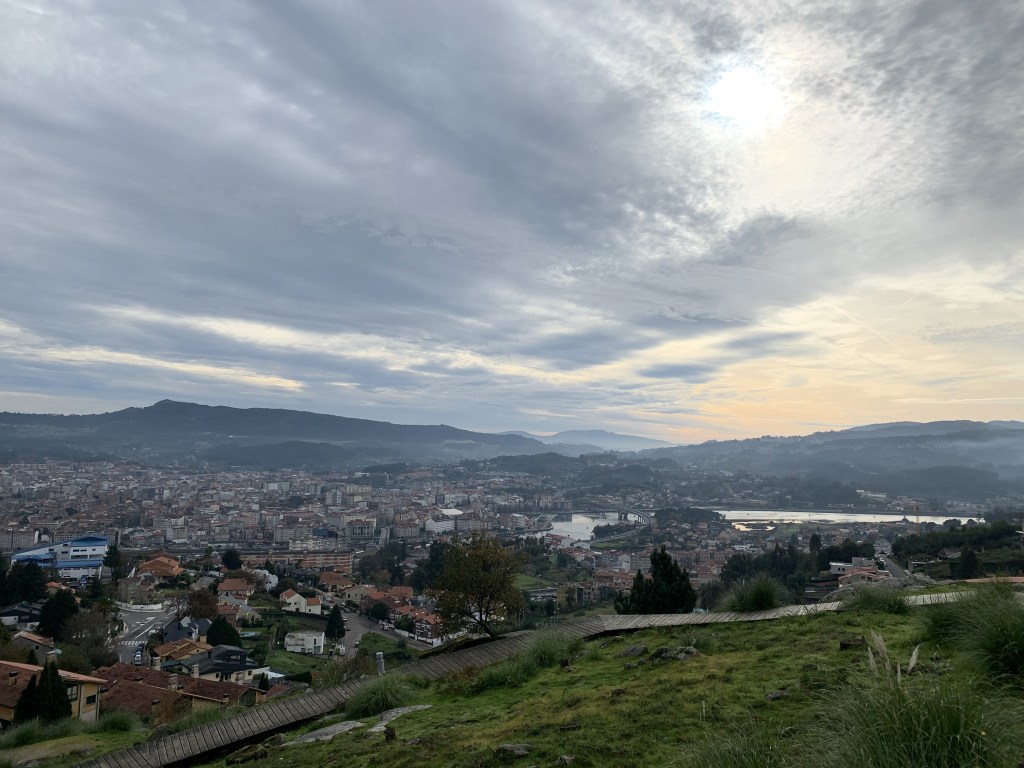
INTRODUCTION
In 1579, a Galician woman named Vasquida Garcia suffered persecution and torture during the Spanish Inquisition. The accusations against her condemned her as a witch, a consort of the devil himself. As a menciñiera, she was a wise woman, or folk-healer, dedicated to curing people’s afflictions and ailments. The unfortunate combination of being a woman with knowledge of healing was unacceptable, and she was eventually sentenced to one-hundred lashes. She was persecuted and tortured because of what that knowledge meant for her as a woman based on how others understood “medicine” and its role – especially against a religious backdrop.
Today, tribute is paid to Vasquida Garcia in a large mural, “Mulleres de Pontevedra na Historia,” dedicated to some of the women in Pontevedra’s history. This wider network of public tributes and memorials to these women are tucked in among the churches and medieval city center that both reflect and hide elements of the city’s past. However, echoes of the past are not only revealed in these mural. Pontevedra is recognized for its urban planning initiatives that are intimately tied to the improvement of its residents’ health and livelihoods. This project seeks to explore previous public health initiatives and its wider connections to medical culture and society, as demonstrated in the city of Pontevedra in the 18th and 19th centuries. Today, the confluence of modern health initiatives and the presence of public history projects celebrating Pontevedra’s women all tie in neatly with themes from the city and province’s past.
PART I
Contemporary Background:
What is Pontevedra (Today)?
The northwest corner of Spain, north of Portugal, where the mountains meet the sea is the land of the Galicians, or gallegos. While not unknown, it is not a widely renowned area of the country. One of the autonomous communities of Spain, Galicia has a rich heritage and history in addition to its culture. This is not an easy area to contextualize, and much of the difficulty of writing about Galicia lies in its identity, which is both fiercely independent while part of the overall Spanish state and wider culture.
Cultural historian Kirsty Hooper explores the concepts of Galician identity and its role in history in her work “Writing Galicia Into the World: New Cartographies, New Poetics.” In it, she provides insights into a lesser known section of Spain. Defining terms of culture and identity are usually complex, and that is the case for Galicia as well. Hooper states that “Galician cultural history is a struggle for control over Galician culture.”[1] The population of Galicia at just under 3 million inhabitants is just a fraction of Spain’s overall population; however, nearly one third of the Spanish expat community have ties to Galicia and thus have a larger role and presence in the world’s view. When writing about Galicia, one must consider the politics of emigration as even today up to a third of Galician men emigrate for economic opportunity. Perhaps a byproduct of this high emigration is morriña, a word used to express a nostalgic longing or even homesickness for Galicia.
For both those who emigrate and those who remain, the culture of Galicia remains vibrant and lively. The region is known – among other things – for its stunning coastline, its fantastic seafood, and the Camino de Santiago. Its four provinces are blanketed with forests, mists, and the rolling mountains, all marking the path from the inland areas out to the sea. I was warmly embraced and accepted without question by gallegos, and many of them worked to share their culture and lives with me; I am forever grateful.
Nestled along the lower half of the jagged Galician coastline, Pontevedra is a city full of charm and history. Once one of the premier and most powerful cities in medieval Galicia, its fortune waned in the 16th century with the shrinking of the River Lérez. While serving as the city’s historical lifeblood, running through the city and out into the sea, the river likely also served as the inspiration for the city’s name. The most widely accepted theory is that its name is derived from the old stone Roman bridge that spanned the river, from the Latin Pontis + Veteris thus yielding Pontevedra.
Home to around 80,000 inhabitants, the city has experienced a reawakening of sorts since the 1990s. The proposals for urban planning and pedestrian zones were initially met with frustration and resistance from residents when the mayor announced them in an effort to improve the city and its citizens’ quality of life, two decades ago. However, today it is one of the trademarks of this city and a source of pride for its residents. The “Metrominuto” pedestrian zone has captured international attention, receiving awards for sustainable development and urban mobility. Additionally, Pontevedra’s pedestrian zone has served as a model for other cities around the world seeking to cut carbon emissions and create safer spaces for pedestrians, thus encouraging foot traffic and cycling.
There are many benefits to the pedestrian system in Pontevedra, including a healthier environment and lifestyle. It is one of the only Galician cities where the birth rate is increasing, and it is popularly known as a good place to raise a family. Known as “reduced movement” friendly, elderly and children alike move about its streets in relative comfort, and it works to mitigate obstacles in accessibility. Today, residents and visitors venture through the city’s heart on foot, bicycle (I can attest to this), scooter, etc., often with children playing soccer in the streets after school.
Of course, more than the occasional peregrino, or pilgrim, hiking the Portuguese branch of the Camino de Santiago are among those passing through the city on foot. The Iglesia de la Peregrina is on the edge of old town, knitting the old and the new together. Its floorplan is in the shape of a scallop shell, the symbol of that ancient pilgrimage. Thus, the role of religion and the Catholic Church’s influence is an essential part of the historical fabric of this city, and the renewed international interest in the Camino de Santiago is a modern connection to that past.
With its old town being younger only to that of Santiago de Compostela, Pontevedra’s significance continues today. The historical structures, monuments, and ruins all draw attention and visitors; additionally, Pontevedra is often considered the heart of the Rias Baixas region and serves as a tourist destination in that way. As common in Galicia, the city is near the sea and ringed by mountains, with vineyards and gardens and casas rurales dotting the land. More than charm, Pontevedra also has strong political significance. The city shares its name with the province, and the city serves as the provincial capital. Various administrative and judicial bodies reside here, and they are scattered amongst the city and its historical center.
As I wandered through the streets of my new city early last fall, different brightly painted murals caught my eye. It seemed to be a series of murals celebrating a variety of women in the city’s story, both past and present. I was intrigued, and I discovered that in fact, yes – the city had undertaken a project that was essentially a public history initiative.
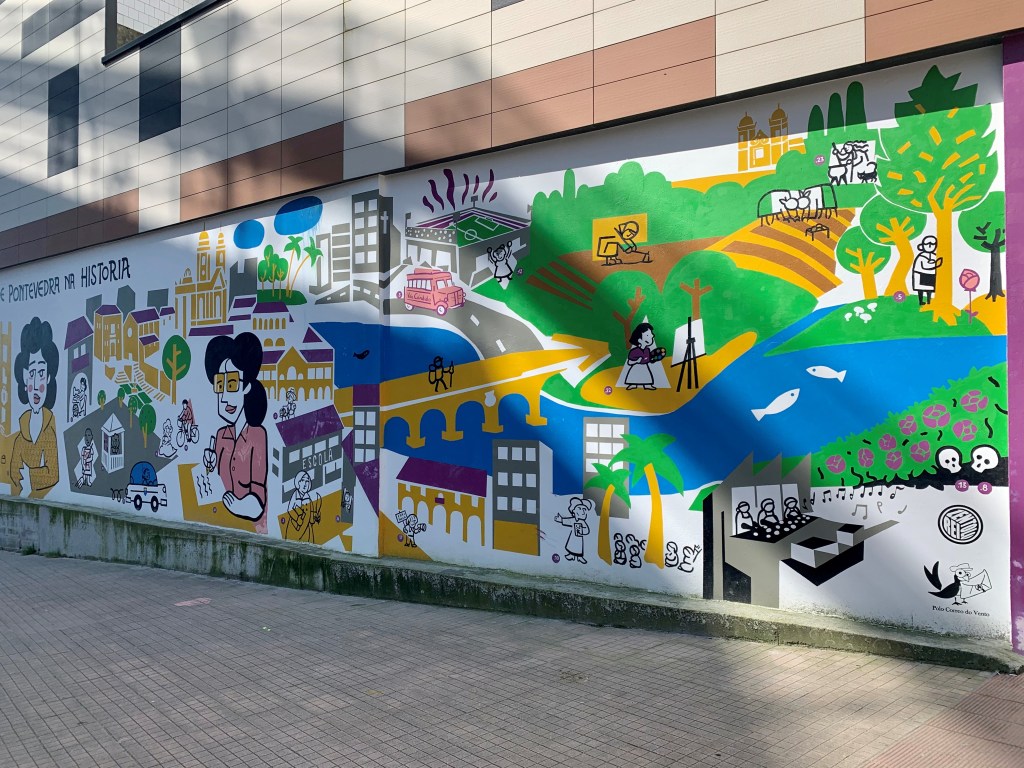
Part of the mural “Mulleres de Pontevedra na historia.” 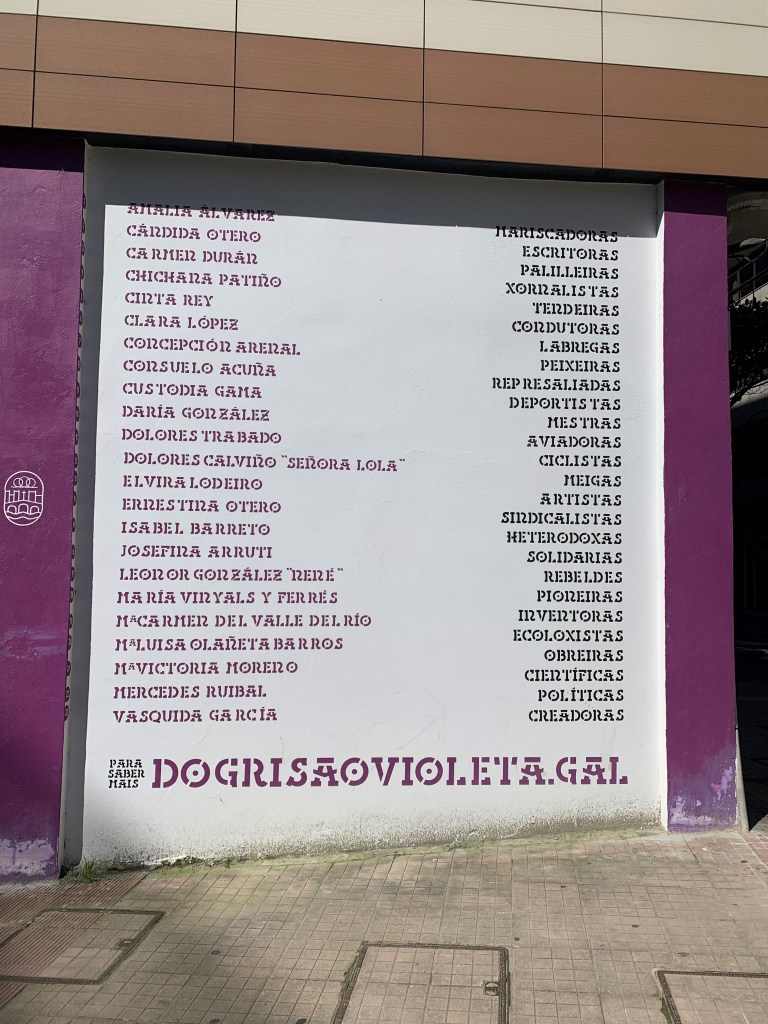
The section of the mural with the names of the local women featured in the project
Just up the street from my old apartment, a large mural stretches along the side of a building overlooking Amalia Álvarez park. Inaugurated in June 2019, “Mulleres de Pontevedra na historia” measures 25 meters long and is beautifully and vividly painted in an effort to pay tribute to notable local women. Amalia Alvarez is featured as the central figure, thanks to her activism in rejecting franquismo after the dictator’s soldiers murdered her husband, and she is surrounded by 22 other Galician women. The right side of the mural has their 23 names written out, alongside their various professions and public roles. Most of the mural is composed of scenes from the cityscape and of Pontevedra, following the River Lérez as it winds through the city from the countryside out to the sea. In this scenery, the 23 women honored in the mural are scattered throughout, depicted in their work that benefitted the city and their fellow citizens.
Newspaper articles explain how the mural is part of the efforts of the Concello de Pontevedra – or the local government – in its A Memoria Das Mulleres project, part of an initiative called Do Gris ao Violeta. Overall, this initiative that started in late 2013 grew out of a desire and commitment to celebrate the women who helped build Pontevedra into the place it is today. As the title suggests, the women of Pontevedra’s past are being brought to public recognition through color in public spaces and history – hence, from gray to violet. Violet certainly was not an accidental choice, being the signature color of Spain’s feminist movement in addition to the internationally accepted color for women’s movements. The initiative consists of events, publications, galleries, and murals.
Referencing back to the main project, Do Gris ao Violeta, a newspaper article reveals how the mural is meant to serve as a way to avoid resigning these women (and thus Pontevedra’s history) “a que a historia for a gris,” – essentially as lost in the pages of history, in a dim gray space. Realizing the goals behind the project as displayed in this particular mural helped me see how the city’s public spaces were full of colorful tributes to its history and to the history of its women.
Thinking about the public spaces of this city in this corner of Galicia, with its connections and juxtapositions, is fascinating. It weaves together public health initiatives, gender roles, and religious undercurrents of the past. How then, did this come to be? What precedent did the urban planners have when they set out to improve the livelihoods of the citizens, and did they intend to improve health overall? Looking into the history of the science and medicine of this place can add meaning to this assortment of questions, and in fact bring them together into the same plane of understanding. Understandings of medicine and the spread of disease have evolved in various societies over time, of course, and the local provincial archives in Pontevedra yield resources to understand a section of that development.
PART II: A HISTORY
The Spaces and Efforts of Public Health
The idea of spaces plays a role in shaping the history of diseases and public health; intricately linked to this is the concept that disease is not an isolated phenomenon, and that it has the power to spread. There are numerous recorded historical examples of doctors and common people speculating and proposing ideas about a disease spreads, including the miasma theory which centered around bad, diseased air. Early modern and modern*[2] records show that the Galicians of Pontevedra understood these principles as their society and time dictated. A document from 1649 served as a notice, announcing that the city was closed to outsiders due to a “peste.”[3] Whether or not this was intended to be a quarantine is unclear, as is the nature of this pest or epidemic; regardless, outsiders were clearly and expressly forbidden from entering the city until the danger had passed. There was a fear of spreading the sickness, which could only further endanger citizens and travelers alike.
Further enforcing the idea of disease, space, and public health was the existence of lazaretos. These were essentially quarantine hospitals or stations for individuals suffering from leprosy but could be used to isolate patients afflicted with other diseases as well. In the 18th and 19th centuries in Spain, some of the largest diseases posing immediate threats were cholera, pneumonia, and leprosy. Medical journals and foreign reports detail the spread of these diseases, their impacts, and sometimes the treatment plans and recommendations of medical professionals.
The doctor D. Lope Valcárcel who authored “La pulmonía y su tratamiento” clearly specialized in pneumonias and lung afflictions, but he responded to a cholera outbreak in the 1890s. After helping patients through the cholera outbreak, he then headed northwest to Galicia – to an “ignored and picturesque” little town.[4] Although he knew it was important to help cholera patients, Valcárcel worried that he would fall behind on his work with pneumonia; fortunately for his studies, there were ample cases in Galicia. This jaunt to Galicia to study pneumonia followed one of the later cholera epidemics, and a better understanding of the illness may have allowed the doctor to move on faster. While some responses to the epidemics of cholera and various fevers involved quarantining the sick, treating leprosy heavily relied on creating spaces for the sick to live away from the healthier population.
The Royal Academy of Medicine and Surgery in Madrid released a report on leprosy in 1860, officially authored by Franciso Méndez Alvaro. It details outbreaks and advances in knowledge about the disease, among other things. A notable aspect is the explicit mention of government intervention and support in areas with outbreaks – the governor of Pontevedra is one, among others, who takes measures to care for and support the lepers in the province. Throughout the work, and others that are similar to it, lazaretos are mentioned over and over. The suffering within these places is unimaginable, with patients separated from loved ones and isolated for fear of spreading a disfiguring disease. Nonetheless, from this doctor’s perspective, they were essential. Isolating the afflicted proved that it is somehow spread and not hereditary, thus providing some scientific understanding of the illness. His overall assessment at the end of the report’s fourth chapter is clearly that the best case scenario remains sequestering the lepers in these lazaretos, as they can only infect each other and thus not causing any outbreaks their home communities.
One such lazarteo in the province of Pontevedra was on the island of San Simon, near Vigo and within the province of Pontevedra. Unfortunately, I did not have the time to look at the collection of documents the provincial archive had in relation to this lazareto. It might have served several purposes, hosting patients afflicted with diseases other than leprosy and possibly serving as a quarantine location during outbreaks of sickness in the port of Vigo. For sure after the island’s tenure as a lazareto, which seems to have lasted until the 1920s, it served as a concentration camp under the brutal dictatorship of Francisco Franco in the years after the bloody Spanish Civil War. Although in a beautiful location, this place has seen a fair share of suffering over recent centuries. As indicated by the circulation of knowledge in medical journals and the existence of lazaretos, there were concrete efforts made to create a semblance of locally run public health systems throughout Spain.
It is clear in historical records of the 18th and 19th centuries that both officials and individual citizens were engaged in efforts to improve the lives and health of themselves and their fellow citizens. A proclamation in 1779, seemingly from the nation’s capital, called for stronger efforts in Galicia for public hygiene. Official publications imposing new rules and regulations, as well as discussions between officials document the slow collection of experience to find a system that was successful – both in its reception and in its function. From local ordinances to letters from concerned individuals to city and provincial officials, efforts were made again to provide support and clarity on public health matters.
A letter addressed February 8, 1850 to a Sr. Alcadade de esta Captial details the successful planning and subsequent implementation of public health measures. The author, Juan de la […indiscernible] is clearly attempting to convince the Sr. Alcadade to support the proposed and newly implemented measures. A critical part of the new public health plan involved implementing and enforcing measures to improve public hygiene in public places. This author strongly credits the policia urbana for their efforts in enforcing the measures and fining individuals who flaunt them. Referencing multas for los descuidados, monetary penalties seem to be a foundational part of the new system and its relative early success. Looking towards the future, the author writes “…el Sistema de limpieza que mas con venga, procurando al ser posible que sea periódico y uniforme …” expressing his hope that this system of public cleanliness will come to fruition, and it will be regulated, uniform, and under a central authority.[5]
Another piece of correspondence from February 1850, although on a different day, discusses a publication from the capital published in the summer of 1848. This document explains the fundamentals that the June 1848 government publication established for public health, and how those principles had been carried out in the community since. The point of the correspondence seems to be simply to share the realities and what has worked for the municipal authorities of Pontevedra, as an “extracto / de la conocimiento del Sistema que actualmente se observa en cuanto a la limpieza publica.” This province has already done what is necessary to clean the streets and public plazas and buildings, with a mention of the involvement of the police in its success. It goes on to share how they encourage neighbors to work together to keep their houses, inside and outside, clean, and thus their shared street clean. Essentially, the author conveys that the reader may do what they will with this info. However, the author takes care to emphasize that a key element in improving public hygiene and upholding the goals of the June 1848 publication is “constante vigilancia” – constant vigilance, presumably on the part of the authorities, but also the individual citizens.[6]
Finally, a new water plan for Pontevedra was proposed in 1886. Its scope was unclear from the initial pages I was able to procure, but the documentation of its breadth and logistics surely exists. This is an example of yet another proposal and initiative led on a governmental level; this model was not unique to Pontevedra. Cities across Spain and other parts of the world were making organized efforts to improve hygiene and water supplies. The benefits of a more hygienic supply were surely evident to different levels of government, health officials, and regular citizens alike; these ordinary citizens involved themselves in the evolving system of public health in the city as they engaged with officials and submitted requests and petitions.
As the local government instituted new standards and fines, the citizens took it upon themselves to hold officials to newer public health standards. An undated letter details a petition from a citizen demanding cleaner streets.[7] It would be interesting to know more about what the initial health initiatives in the city focused on and how “public places” were defined – apparently at least one street was neglected. Another undated petition features signatures from a group of citizens, including Señores Don Josef de Pazos and Don Santiago Sallexas de Sotoma, among other less discernible names.[8] Addressed to public officials, “Sres. Justicia y Regimiento, Villa de Pontevedra,” this group petition explained how the individuals, their families, and the neighbors are suffering from terrible smells, of some unknown pestilence. They believe it must involve issues of public cleanliness on the street, and thus bring it to the attention of the Justicia y Regimiento.
Hospitals were obvious places that played a role in health (for both communities and individuals), as well as a role in understanding of disease and evolving medical care. An interesting element displayed in the of hospitals in Pontevedra is the interaction of the Catholic church and the local government in its operations and funding. The Hospital of San Juan de Dios in Pontevedra seems to have been affiliated with both the Church and the municipal authorities in Pontevedra. An inventory of the works and effects belonging to the hospital and its patients is dated May 3, 1838. I did not get to read and translate many of the documents inside this folder, but the opening pages demonstrate connections between government and hospital administration; additionally, the hospital seems to function well and has proper supplies and patients who need attention. In short, it is striving and apparently succeeding to meet the needs of the community while juggling the complexities of competing administrative jurisdictions.[9]
Clearly demonstrating the tensions in the hospital’s administration and its role of care for all sick, including the destitute, is a 1797 letter from a hospital official. The official writes of the strain that “poor pilgrims” were putting on the local health system and the hospital. The official laments that these poor pilgrims and Portuguese arrive and seek care, sick and ill with an assortment of maladies, but then struggle to pay for the services. How is the hospital to go on when their patients are frequently of this sort, as the local poor also seek assistance? The letter appears addressed to the “Justicia y Regimiento de la Villa de Pontevedra” and provides a tantalizingly brief glimpse into the institutions and organizations that supported hospitals. There is a clear government role here, but allusions to religious affiliation and support as well.
Thus, here is one essential element already present in this story that seeks to understand more about the history of science and medicine: religion, specifically Catholicism, and its historical power in Spanish society. In that late 18th century letter, the Camino de Santiago and ties to the catholic Church underlie the presence of poor pilgrims; Pontevedra is a well-known and extensively documented city on the Portuguese route of the renowned pilgrimage to Santiago de Compostela. Additionally, attitudes about immigration peek through in this letter, as the official is displeased about the presence of Portuguese seeking care. This adds value to the document, as it hopefully gives the contemporary reader pause about how we (Americans, Spaniards, etc.) think and talk about immigrants crossing and within our own borders today. Religious or not, there is certainly something to consider and explore in connection to our modern realities in these disparaging attitudes towards fellow human beings in this 1787 letter. The Hospital of San Juan de Dios is dissatisfied with its role as a provider for these destitute (religious or otherwise), and this official must have had some hope that the local government can do something to mitigate the strain.
In contrast, a folder titled “Asuntos del Hospital de Lazarados” introduces an independent hospital not under the control of the Justicia y Regimiento: “hay un hospital titulado de la Virgen del Camino y Lazarador independente de su santuario.” Documents describe the medical staff’s efforts to provide care while avoiding disturbance to the local community and neighborhood. The author notes that there are balconies, presumably so that the infirm can breathe in and enjoy fresh air. It is strongly noted that these balconies keep the sick away from the healthy; in fact, effort is made to emphasize that the facility as a whole keeps the patients separate from the surrounding healthy people. This independent hospital does not pose a public health threat. Unfortunately, I only had the time to work with the initial pages of this document, so the nature of the presume inquiry of the letter was not uncovered before the pandemic shuttered us inside. It seemed to be building up to some request, or perhaps the author was introducing the independent institution in order to propose some sort of cooperating project. However, an important takeaway from this private, independent hospital demonstrates an awareness of sickness and concerns over how the wider community views the hospital and its potentially infectious patients.
Influence, Funding, and Authority: Public versus Private
Many of the sources from the Pontevedra Provincial Archives (with a focus on the late 18th century and 19th century) demonstrate some level of government initiative and involvement in public health efforts. Individual voices of common citizens are also present. Which voices have influence and authority, and who decided which were of value? Furthermore, how did the vast array of figures and councils overlap and interact with each other? The organization of the Justicia y Regimiento seems to be related to the government, and one of the letters was addressed to “Sres.”, thus indicating that men only sat on this board; this is not a surprise given the social structures and gender social roles especially defined in the upper class. However, the hospitals’ connections to a private entity and the Catholic Church reveal that government was not the only authority or institution involved.
Another important connection to examine is the role of (private) charity. To consider how charity could be defined in a particular context, who is involved, and how much influence a donor may exert over the institution is one way to seek deeper understandings about a particular society and its institutions. Were there any of these intersections in Pontevedra, and how did they interact?
To the city (and society more broadly), the poor were both a general issue as well as a specific public health threat as seen in letters and edicts laying out measures to improve hygiene and treat the infirm, many of whom were the poor. But what was the city to do with impoverished young individuals, without parents or homes? An orphanage was founded in 1674 to care for these children and keep them off the streets. A thick folder containing many records of the orphanage and its activities over the years likely holds answers I did not have a chance to really seek. How were the orphans cared for, and how were they perceived by the city’s inhabitants? Another angle to explore is funding: were all the funds public, were wealthy benefactors involved, and did the Catholic Church exert any control over the orphanage? All three of these scenarios seem plausible given historic precedent, but I cannot know for sure. We definitively know that an orphanage was established and continued to exist in Pontevedra; what other independent organizations existed to serve the charitable needs and shortcomings of the local community, and what did their work entail?
One such organization I encountered in my (too short) time in the Provincial archives is called the “Junta Municipal de Beneficencia de la Villa de Pontevedra,” [roughly translating as the Municipal Charitable Board of the City of Pontevedra] which existed as early as at least 1823. What was the nature of their work? Perhaps they eventually had an affiliation with the orphanage, thus overlapping with other institutions. I did not have a chance to truly find out. However, other organizations can provide a model to theorize their actions and involvements in their local community.
In other similar organizations, such as the Junta de Damas de Honor y Mérito in Madrid,*[10] there were definitive connections between women in charitable organizations and their spouses in government roles and offices. Was this the case in Pontevedra? It would be interesting to see how this charitable organization interacted with the local government agencies – if at all – and how that affected policy or funding outcomes. The women listed in the Junta Municipal de Beneficencia of Pontevedra in the 1838 register were all listed as “Doña,” an honorific title for upper class, distinguished women. It is not a stretch to wonder if any of these women had husbands involved in local or regional government, and how that may have impacted the organization’s networking and goals. The unknown yet alluring potential network between this women’s group, the church, and local government – and how that network shaped public health infrastructure and the public attitudes of the city and province – is fascinating.
Philanthropy served as a space for women to have a public voice and agency; it should be noted that this was generally an area populated by upper class women. One factor that left so few public spaces for any women was the perception that women ought to dutifully occupy the private sphere of the home, acting as an “Angel del Hogar,” or an angel of the home. Looking at Spain more broadly in the 19th century, the role of women in society was determined by larger sociocultural attitudes, which were in turn influenced by established institutions. Francisco Pi I. Margall wrote in his 1869 work La Misión de la mujer en la Sociedad that the role of women was simple yet integral. A woman, “que es todo amor, todo sentimiento” is to remain in the home, providing her family with emotional support; critically, her grandest mission is the education of her children. These sentiments are echoed in parallel contemporary writings, written by both men and women. Not just found in academic and professional settings, these ideas were reinforced in common publications accessible to literate women capable of holding a subscription to the publication such as the Correo de la Moda. Thus, scholarly and common literature defined and demanded the role of a virtuous, middle and upper class Spanish woman.
These gender roles fit into wider social norms, which were shaped and influenced by many factors and authorities. The medical culture of a time and place, that is how medicine is practiced and understood in a community, can be a dramatic factor in this construction the role of women. Often in conjunction with religion, that application of science and medicine in society is proven to be a powerful force over and over again. The expansion of medical knowledge of the female body in turn provided commentary on the female condition itself. A significant portion of a woman’s role and status in the latter half of the 19th century was guided by medical knowledge and understanding of female anatomy and physiology. Women’s bodies were scrutinized and studied, resulting in new medical knowledge and led to wider public discussion over the nature of women.
In particular, writings on gynecology were significant, as they revealed the workings of the biologically female body to the world; they remained rudimentary compared to modern standards, while acting as defining evidence for the status of proper Spanish women in society. This science and knowledge of the woman quickly evolved from the basic female anatomy of genitalia to its physiology, thus determining larger, scientifically-backed theories about the inferiority of women in comparison to the biological stability of men.
Thus, the Junta Municipal de Beneficencia (de la Villa de Pontevedra) captured my attention, in part because of the potential actions in the community, but also due to the background ideas about the biologically based nature and role of women in society. It tied into my interests, my previous research, and quite possibly future studies. The historical precedent displayed by similar organizations in other Spanish cities that invoked philanthropy as a driving force in their work reveals potential in the actions and impacts of this group in Pontevedra. How this women’s group in Pontevedra utilized possible connections with other institutions – government, religious, private, or otherwise – remains to be seen. Nevertheless, their records exist and prove that these women indeed did gain a foothold in the public sphere, despite prevailing sentiment and notions of their worth as defined by long-held social standards justified by emerging medical knowledge.
CONCLUSION
Fast forward to modern Pontevedra, the place where I walked and biked to clases particulares or to meet friends for a caña. This Pontevedra is defined by its acclaimed pedestrian zone, and the city supports a local movement that is publicly displayed that is dedicated to publicly writing its women back into its history. These modern day elements point to critical junctions in Pontevedra’s past.

Iglesia de la Virgin Peregrina // Capela Da Virxe Peregrina – a stop on the Camino Portugués 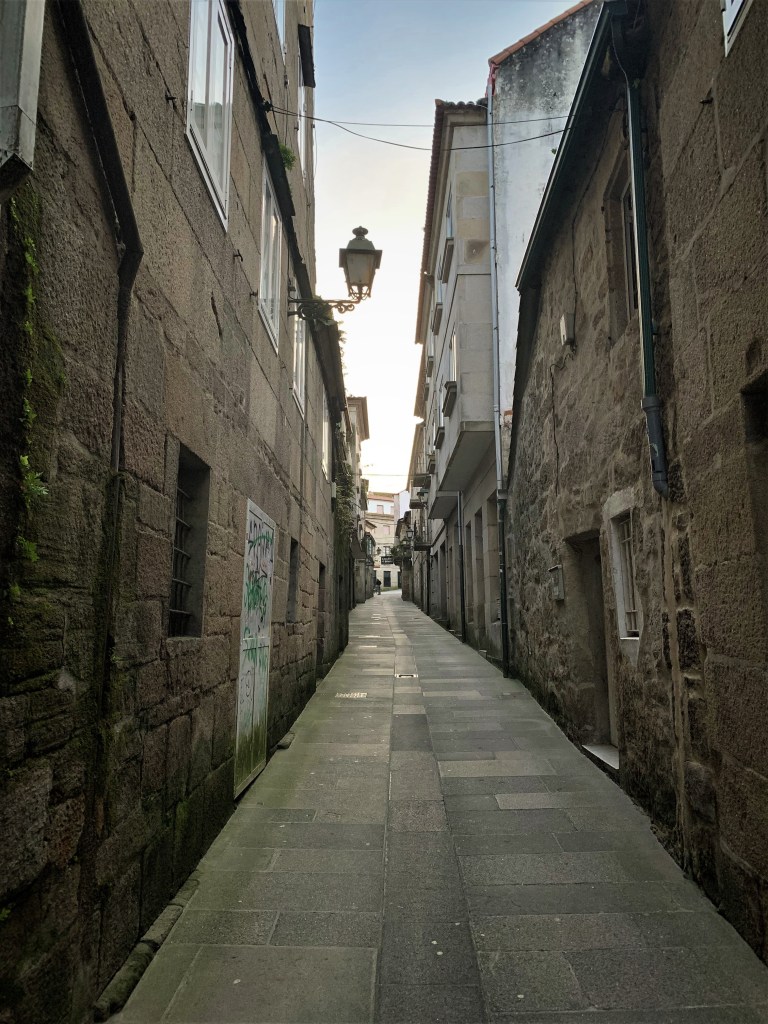
a street in old town 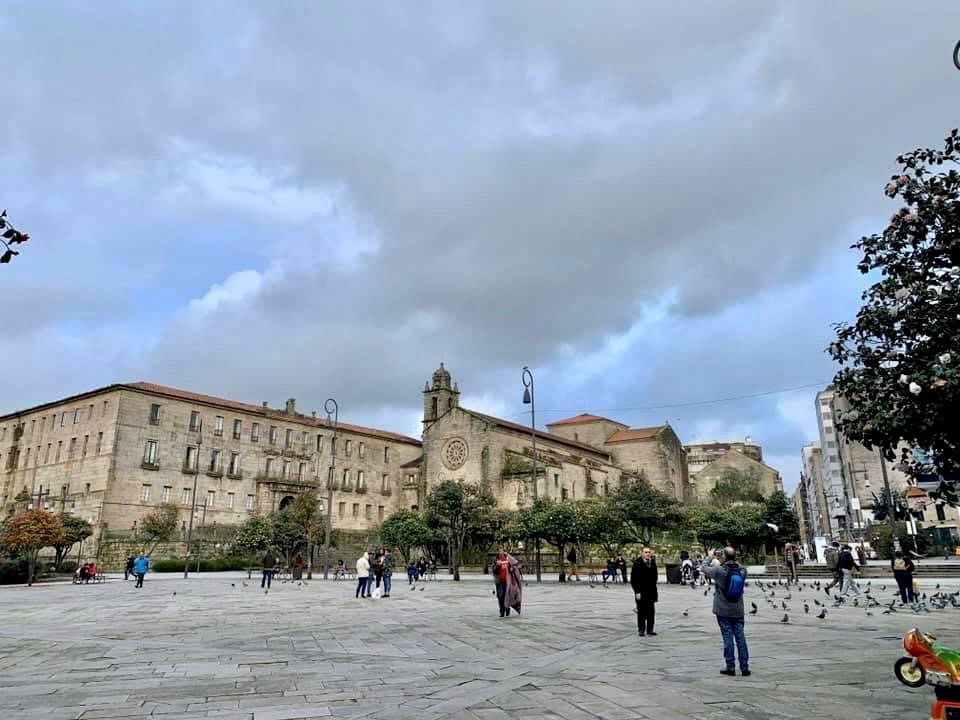
Plaza de la Estrella 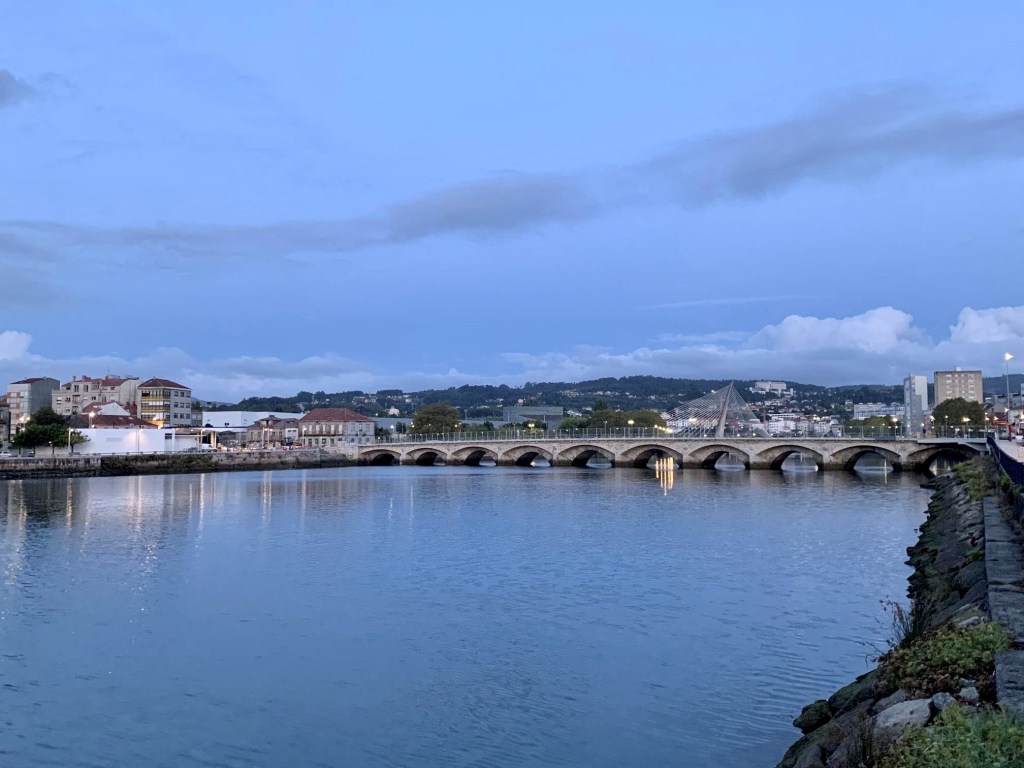
The historical spaces of public health and their connections to various public and private institutions highlight how humanity has fought to understand and treat illness and disease in systematic ways. This is always relevant, but painfully so today. Various actors sought improvement in their lives and surroundings, utilizing a variety of means to enact what they hoped would be positive change. These figures were overwhelmingly men, given the social norms and expectations, but women found ways to be involved and develop a sense of agency and even influence – as displayed in today’s murals throughout the city. The role and power of the Catholic Church in Spain is even more distinctly represented and memorialized in Galicia due to the presence of the Camino de Santiago. Whether pilgrims today hike the paths to Santiago for religious, spiritual, or personal reasons (etc.), its history remains a tie to that past influence and it connects to Pontevedra in its physical sites and landmarks. In fact, all of these concepts affect the modern spaces of the city and are indelible in its historical legacy.
There are many unfinished avenues that this project only began to probe, not least of which involve the nature and actions of the Junta Municipal de Beneficia. Furthermore, in studying that women’s group one must delve further into the experience of lower class, poor women and how they may have navigated and resisted the oppressive status quo. A medically-minded space that was long afforded to women was midwifery, but with the rise of gynecological studies and other medical investigations into the female body, that was rapidly lost to rising male medical professionals in the aftermath of the Enlightenment. How that may have played out not only in Spain generally but in this northwestern corner of the country would be notable. Of course, tracing the outcomes of some of these public health measures in specific epidemics was beyond the scope of this project, but it would be fascinating. Finally, examining divisions of class, racial divides, and any distances between religious communities in Pontevedra within the scope of this subject would only enrich our growing understanding of how our complex sociocultural realities, constructed as they are, define and shape both histories and present conditions.
So, in celebrating the modern accomplishments of Pontevedra and exploring its historical roots, we can begin to understand more of the story. As a city in an often-overlooked region of Spain, this project adds perspective to the social construction of public and private spaces and its implications for women, as well as insight into how public health was carried out. Long after the condemnation and persecution of Vasquida Garcia, women were still prevented from having active, public roles in medicine or health-related matters.
The role of history matters, both in attempting to give a voice to individuals in the narrative, as well as examining the idea of the historical truth. There is an obligation in the craft of history to commemorate and convey the past in the most truthful way that we can. I want to note that in this regard, we are facing a necessary reckoning in the United States that is a painfully long time in the making.
In Pontevedra, one way to celebrate the beginning of the search for deeper truth involved painting women’s achievements on a wall – what a beautiful beginning to the sharing of a long, rich story. Many extranjeros may know the meaning of morriña…but for those of us who came to call Galicia home, we feel this morriña and will be forever connected to these chapters of our stories set in Galicia.
Sources
Quick Links:
- https://www.dogrisaovioleta.gal/
- https://www.farodevigo.es/multimedia/videos/sociedad/2019-06-13-177278-murales-pontevedra-mujeres-historia-pontevedra-cobran-vida-color.html
ENDNOTES
[1] Kristy Hooper, Writing Galicia into the World: New Cartographies, New Poetics, (Liverpool: Liverpool University Press, 2011), 8.
[2] Generally speaking, the Early Modern period is considered to be 16th century – end of 18th, while the Modern Period is considered to be the start of the 19th century onwards.
[3] Title Unknown, 1649, Leg 59(2), Sanidade (No. 1475-1494), Tome I, Arquivo Histórico Provincial de Pontevedra.
[4]Lope Valcárcel Vargas, La pulmonía y su tratamiento (Pontevedra: Imp. Y Librería de Andrés Landín, 1894), Biblioteca Nacional de España.
[5] 71(15) Policia Urbana (to Sr. Alcalde de este Capital), February 8, 1850, Leg 71(15), Limpieza Publica (No. 1384-1388), Tome I, Arquivo Histórico Provincial de Pontevedra.
[6] Correspondence to “A la [indiscernable] de esta Provincia de Pontev.” February 18, 1850, Leg 71(18) Limpieza Publica (No. 1384-1388), Tome I, Arquivo Histórico Provincial de Pontevedra.
[7] [1] “Petición” September 20, 1840, Leg 71(60), Limpieza Publica (No. 1384-1388), Tome I, Arquivo Histórico Provincial de Pontevedra.
[8] Petition to Sres de Justicia y Regimiento, 1803, Leg 81(6), Limpieza Publica (No. 1384-1388), Tome I, Arquivo Histórico Provincial de Pontevedra.
[9] “Inventario de los bienes y efectos pertenecientes al Hospital de San Juan de Dios de la cuidad de Pontevedra,” 3 de Mayo de 1838, Leg 5(7), Beneficios (No. 1092-1120), Tome I, Arquivo Histórico Provincial de Pontevedra.
[10] * I wrote more about this in my senior thesis at Creighton University: Columbia Journal of History, Summer 2019 Edition: Volume 3, Issue 2. https://www.columbiahistoryjournal.com/wp-content/uploads/2019/06/CJH-Summer-2019.pdf
PRIMARY SOURCES
Asociación de Benefica de Señoras de Pontevedra, 1866, Leg 71(37), Beneficencia Publica (numbers not recorded), Tome I, Arquivo Histórico Provincial de Pontevedra.
“Asuntos del Hospital de Lazarados” (date not recorded in my notes), Leg 5(16) Beneficios (No. 1092-1120), Tome I, Arquivo Histórico Provincial de Pontevedra.
Barreiro de W., Barnardo.Brujos y astrólogos de la Inquisición de Galicia y el famoso Libro de San Cipriano. Coruña: Imprenta de La Voz de Galicia, 1895. Biblioteca Nacional de España.
“Copia de la Fundacion de las Húerfanas,” [date not recorded in my notes], Leg 5(2), Beneficios (No. 1092-1120), Tome I, Arquivo Histórico Provincial de Pontevedra.
“Espediente relativo de la Junta municipal de Beneficencia de la Villa de Pontevedra,” 1823, Leg 5(4), Beneficios (No. 1092-1120), Tome I, Arquivo Histórico Provincial de Pontevedra.
“Fundacion de las Húerfanas de Pontevedra, hecha por el Maestre del Campo Don Pedro Valladanes, en el Año 1674,” 1674, Leg 5(1), Beneficios (No. 1092-1120), Tome I, Arquivo Histórico Provincial de Pontevedra.
“Junta Municipal de Beneficencia de Pontevedra,” September 23, 1866, Leg 71(38), Beneficencia Publica (numbers not recorded), Tome I, Arquivo Histórico Provincial de Pontevedra.
“Junta Municipal de beneficencia de Pontevedra: Individuos que la componen,” January 28 182[?], Leg 5(12), Beneficios (No. 1092-1120), Tome I, Arquivo Histórico Provinicial de Pontevedra.
Letter regarding the Hospital San Juan de Dios, addressed to “Justicia y Regimiento de la Villa de Pontevedra,” 1797, Leg 5(15) ) Beneficios (No. 1092-1120), Tome I, Arquivo Histórico Provincial de Pontevedra.
Méndez Álvaro, Francisco. La lepra en España a mediados del siglo XIX: su etiología y su profilaxia / memoria presentada a la Real Academia de Medicina y Cirugía de Madrid por su socio de número D. Francisco Méndez Álvaro. Madrid, Imp. De M. Rojas, 1860.
Pastor y López, Pascual. ¡Guerra al cólera morbo! [Texto impreso] : sea Instrucciones que contra esa calamidad debe tener presentes el público. Valladolid: Imp. De Julián Pastor, 1854.
Policia Urbana (to Sr. Alcalde de este Capital), February 8, 1850, Leg 71(15), Limpieza Publica (No. 1384-1388), Tome I, Arquivo Histórico Provincial de Pontevedra.
“Provincia de Pontevedra: Numero y clase de los Establecimientos de Beneficencias…” July 1867, Leg 71(36), Beneficencia Publica (numbers not recorded), Tome I, Arquivo Histórico Provincial de Pontevedra.
“Provisión,” 1779, Leg 34(9), Limpieza Publica (No. 1384-1388), Tome I, Arquivo Histórico Provincial de Pontevedra.
“Spain Vital Statistics during the Years 1886-1892.” Public Health Reports (1896-1970) 11, no. 28 (1896): 637-38. www.jstor.org/stable/41439304.
“Statistical Reports.” Public Health Reports (1896-1970)11, no. 9 (1896): 194-96. www.jstor.org/stable/41436897.
Title Unknown, 1649, Leg 59(2), Sanidade (No. 1475-1494), Tome I, Arquivo Histórico Provincial de Pontevedra.
Valcárcel Vargas, Lope. La pulmonía y su tratamiento. Pontevedra: Imp. Y Librería de Andrés Landín, 1894. Biblioteca Nacional de España.
Whelpley, P. M., Victor Vifquain, and John B. Hamilton. “Abstract of Domestic and Foreign Sanitary Reports Received during the Week Ended September 13, 1889, Published in Accordance with Section 4, Act of Congress, Approved April 29, 1878.” Weekly Abstract of Sanitary Reports 4, no. 37 (1889): 281-86. www.jstor.org/stable/43806600.
SECONDARY SOURCES
Barbier, Jacques A., and Lynda DeForest Craig. “Lepers and Hospitals In The Spanish Empire: An Aspect of Bourbon Reform In Health Care.” Ibero-amerikanisches Archiv, Neue Folge, 11, no. 4 (1985): 383-406. http://www.jstor.org/stable/43392436.
“Biografías.” Do Gris ao Violeta. Concello de Pontevedra, 2020. https://www.dogrisaovioleta.gal/biografias/
Contreras Dueñas, Felix. “Leprosy in Spain.” International journal of Leprosy. 1947; 15 (2): 178-82. http://ila.ilsl.br/pdfs/v15n2a07.pdf
“Do Gris Ao Violeta: Achegas Á Historia Das Mulleres De Pontevedra.” Do Gris ao Violeta, Homepage. Concello de Pontevedra, 2020. https://www.dogrisaovioleta.gal/
Espiño, Alejandro and Monica Patxot. “Un mural que ‘salda a débeda’ de Pontevedra con las mujeres que no se resignaron ‘a que a historia fora gris’. ” Pontevedra Viva.com. Pontevedra Viva, June 14, 2019. https://pontevedraviva.com/xeral/55439/inauguracion-mural-memoria-mujeres-pontevedra-historia/?lang=es
Hooper, Kristy. Writing Galicia into the World: New Cartographies, New Poetics. Liverpool University Press, 2011. Doi:10.5949/UPO9781846316807.
“Murales en Pontevedra: Las mujers de la historia de Pontevedra cobran vida y color.” October 28, 2019. Video, Faro de Vigo. https://www.farodevigo.es/multimedia/videos/sociedad/2019-06-13-177278-murales-pontevedra-mujeres-historia-pontevedra-cobran-vida-color.html
 my fulbright year